Feature · Deterministic DNO routing
It tells you the route. Then it tells you why.
CLRD reads the job, the MPAN, the phase, the kW, the batteries and the export limit, and routes it to the right DNO and the right form, G98 or G99, including where Fast Track applies. Then it shows you the reasoning that got there.
What it is
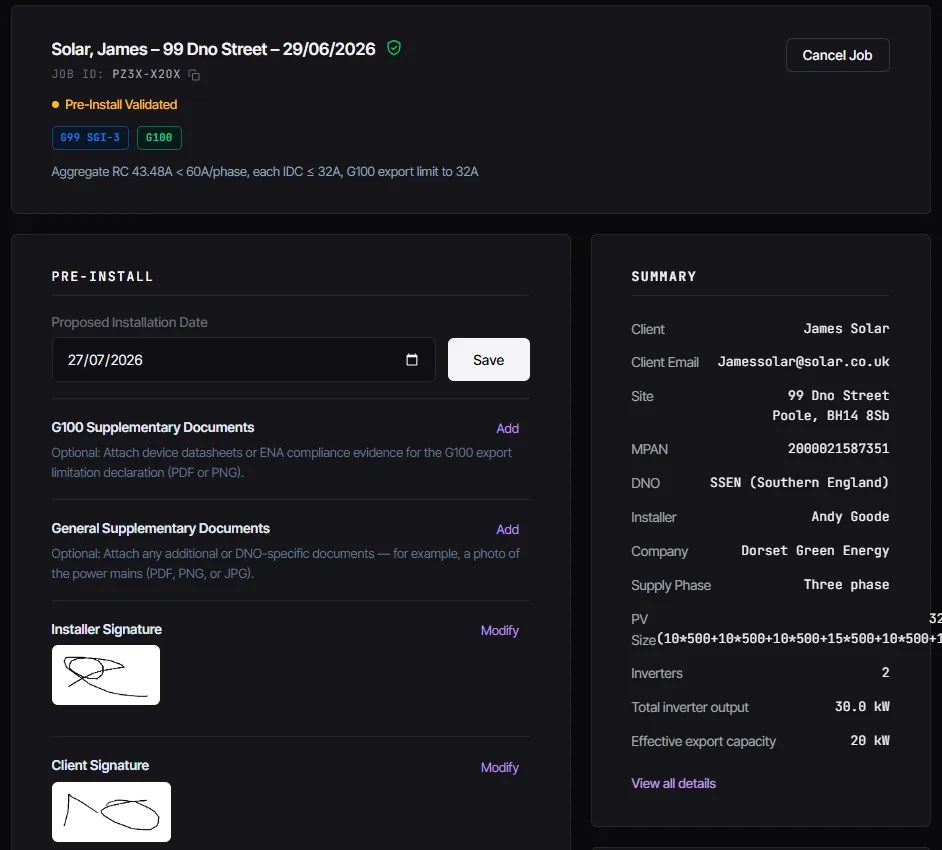
A deterministic routing engine. It reads every job and selects the DNO and the form, G98 or G99, including where Fast Track applies, with G100 evidence attached wherever the job is export limited. The reasoning is shown alongside the decision, not just the outcome.
Why it matters
The wrong form is one of the common reasons an application comes back, and ENA Connect Direct will accept the wrong one from you without comment. CLRD decides from the published thresholds rather than from memory. On a recent job, an aggregate registered capacity of 34.78 A did not meet the SGI criteria, so it routed G99 General Type A and said so on the job. When a DNO or an auditor asks why later, the answer is still there.
Two people, the same job, the same route.
- Routing built from the published ENA thresholds.
- MPAN to DNO resolved from the distributor id, kept current.
- The reasoning shown on every decision, not just the outcome.
- G100 evidence attached wherever the job is export limited.
- No overrides and no exceptions. Two people, one job, one route.
 Enlarge
In practice
What changes on the next job.
The same route, whoever runs it
Two engineers, one job, one answer.
The reasoning travels with it
Why a job went where it did, recorded on the job.
Defensible later
Show a DNO or an auditor the threshold that decided it.
Before & after
With CLRD vs. without.
See deterministic dno routing on your own jobs.
A 30-minute demo with a real install, yours or ours.