The DNO Guide. UK solar DNO applications, explained.
What a DNO actually is, what G98, G99 and G100 mean, what goes in an application pack, and how to submit one, start to finish. Written by people who've worked in the industry and dealt with the problems first hand, for people moving across into solar, new starters at installer firms, and the ops teams keeping it all moving.
New to this and it feels like a lot? You're in the right place. Everyone in the industry learned it the hard way. You don't have to.
Start here
The five minute version.
The DNO, the Distribution Network Operator, owns and runs the local electricity distribution network in your area. That's separate from the customer's electricity supplier, two different things. Any grid connected solar PV or battery system either gets notified to the DNO after commissioning, or approved by the DNO before it's energised. Which route you're on comes down mainly to the declared generation, the export arrangement and the capacity.
At or below 16A per phase, roughly 3.68kW on a standard single phase supply, the install usually falls under G98. You can install and commission, then submit the DNO notification within 28 days. Above that threshold you're usually into G99, which needs approval before energisation. G100 applies where export limitation is used to cap the maximum export onto the network.
The submission pack is the set of documents and data the DNO needs to assess or record the connection. That normally means the correct G98 or G99 form, the single line diagram, the inverter make and model, the ENA type test reference, the site address, the MPAN, and a signed letter of authority where you're submitting on behalf of the property owner. G100 jobs also need export limitation details that match the declared export limit and the SLD.
In plain terms, the job needs the right route, the right DNO, and a pack where the form, the equipment data, the MPAN, the SLD and the supporting documents all agree. Get one of those out of step and that's where applications stall. The rest of this guide walks through each part, where jobs commonly get delayed, and what to check before you submit.
Part 01
The system
Who runs the wires, who writes the rules, and which network you're actually dealing with.
What a DNO is, and what it is not
A DNO is a Distribution Network Operator. It owns and runs the local electricity distribution network in a set region, the underground cables, the overhead lines, the substations, the service connections and all the network kit that goes with it.
The DNO's job is to keep that local network running and to manage anything new connecting to it. So for solar PV, battery storage and any other generation, they want to know what's being connected, where, how much it can generate or export, and whether it needs approval before it's energised.
A DNO is not the customer's electricity supplier. That's the bit people mix up. Suppliers like Octopus, British Gas or EDF sell the electricity and handle the billing. The DNO owns the physical network that actually delivers it to the property. A customer can switch supplier whenever they like, but they can't pick their DNO. That's fixed by where the property sits and which network region it's in.
Some properties, new build developments especially, or private networks, connect through an IDNO instead, an Independent Distribution Network Operator. The same connection standards apply, but the application goes to the IDNO rather than the regional DNO, so it's worth checking which one you're dealing with before you submit.
Which DNO is yours
There are six DNOs covering Great Britain, each with a fixed patch:
- UK Power Networks (UKPN), London, the South East and the East of England.
- National Grid Electricity Distribution (NGED), the Midlands, South West England and South Wales.
- SSEN, central southern England and the north of Scotland.
- SP Energy Networks (SPEN), central and southern Scotland, Merseyside, Cheshire and North Wales.
- Northern Powergrid (NPg), the North East, Yorkshire and northern Lincolnshire.
- Electricity North West (ENWL), the North West of England.
The reliable way to identify yours is the MPAN on the electricity bill, the first two digits of the bottom row identify the network region. A postcode search on the ENA website does the same job.
How CLRD handles this
The ENA, who writes the rulebook
The Energy Networks Association, the ENA, is the industry body for the UK energy networks. They're the ones who write the rule book, the engineering recommendations that govern how generation equipment connects to the distribution network. G98, G99 and G100 all come from them. Every DNO works to those same standards, even if each one has its own portal and its own admin quirks on top.
The ENA also holds the type test register, the list of inverters that have been type tested against those connection requirements. The type test reference is a key part of the submission pack, because it tells the network operator exactly which certified inverter is going in.
Where a job needs export limitation, it has to be declared, either inverter integrated or external. If it's inverter integrated, it shows on the SLD and the chosen export limit has to be set at installation. That's the whole reason type tested inverters matter here. They're the ones proven to hold that export setting the way the declaration says they will.
This is where a lot of jobs get held up. A wrong or mismatched type test reference is one of the most common reasons a DNO comes back. The inverter make, model and ENA reference all have to match the form, the SLD and the actual kit on site, and where there's an export limit, the declared limit has to match what's set on the inverter. Get one out of step and you're into back and forth.
Part 02
Why any of this matters
The paperwork isn't box ticking for its own sake. There's real engineering behind it, and once you know what the DNO's actually worried about, the rest of the process stops feeling arbitrary.
Why the DNO cares about solar at all
Solar doesn't just feed the house it's bolted to. Whatever that house doesn't use flows back out onto the street, and the local network was built for power running the other way, from the substation to the homes, not from the homes back up.
Push enough export into one area and you start loading cables and transformers that were sized decades ago, long before anyone on that street had panels. Street voltage has to stay inside legal limits, and every exporting system nudges it up a bit. Kit that misbehaves during a fault can turn a small problem into a big one. And when an engineer's about to put hands on live wires in an emergency, they need to know what's connected where before they start.
That's the whole reason the DNO wants to know. Not to make your life hard, to keep the network they're responsible for inside its limits.
In short
What actually happens if you don't tell them
Honest answer: nobody turns up the next morning. That's exactly why unregistered systems are out there. But the problems don't arrive on install day, they arrive later, and they cost more when they do.
An unregistered system has no record with the network, and that gap shows up at the worst possible moments. Selling the house, the buyer's solicitor asks for the DNO paperwork. Claiming on insurance after an electrical fault, the insurer wants it too. Signing up for export payments, the supplier wants evidence the connection's legitimate. And if the DNO finds an unnotified system causing a network problem, they can make you disconnect it until the paperwork's put right.
The notification itself is free, and for small systems it's quick. There's no good reason to skip it.
If a system's already in and was never registered, it can still be regularised. You contact the DNO and submit the paperwork retrospectively. They deal with it more often than you'd think, and a late notification beats none every time.
Part 03
The paperwork, decoded
Three standards cover nearly every solar job in the country. Once you can tell them apart, most of the mystery is gone.
What a DNO application actually is
A DNO application tells the network operator exactly what is being connected at a property: where it is, what equipment, how big, and how it's wired in. The single most useful distinction in this whole subject is between the two kinds:
A notification is after the fact. You install, you connect, then you tell the DNO what you did. That's the G98 world.
An application for approval is before the fact. You describe what you intend to install, the DNO assesses whether the local network can take it, and you wait for a yes before energising. That's the G99 world.
People say "DNO application" or "DNO pack" for both, which is fine, but knowing which side of the line a job sits on tells you if you're allowed to connect yet. Get that wrong and you've either sat on your hands waiting for an approval you never needed, or energised something you weren't cleared to.
The G98 application, the smaller system route
G98 covers generation at or under 16A per phase, about 3.68kW on a normal single phase supply. That's most standard domestic solar with a modest inverter.
The deal is connect first, notify after. Install it, switch it on, then send the DNO the completed G98 form within 28 days of commissioning. They don't approve or reject it, they just need the record.
One catch worth knowing: the 16A limit is per phase and per property, and it includes what's already there. Add a second system, or a battery, to a property that already has G98 solar, and the total can tip over the line into G99.
The G99 application, the approval route
Anything above the G98 limit needs a G99 application, approved before the system's energised. In practice that's bigger domestic systems, most systems with a decent battery, three phase installs, and effectively all commercial work.
The DNO's engineers check whether the local network can take the export: cable ratings, transformer capacity, voltage headroom. For a standard low voltage connection you're usually looking at around two weeks for an initial response on a smaller type tested system, stretching to around ten where a full design study is needed. It varies by DNO and by how loaded the local team is. If the network needs reinforcing to take your connection, they tell you, along with what it costs and how long it takes.
The discipline that matters: do not energise before the approval lands. Connecting a G99 scale system without consent is a breach of the connection agreement, and the DNO can make you disconnect.
How CLRD handles this
G100 and export limitation
G100 is the standard for export limitation, and it's the most useful tool most people have never heard of. It lets you install a system bigger than the network could normally accept by capping how much it exports.
Say the local network can only take 5kW of export but the customer wants a 10kW system with a battery. With a G100 compliant limitation scheme, the system generates its full 10kW, the house and the battery use what they can, and the export to the grid is held at the agreed limit. The DNO gets certainty, the customer gets their system.
The evidence has to line up though. Where a job needs export limitation it gets declared, either inverter integrated or external. If it's inverter integrated, it shows on the SLD and the chosen limit has to be set at install. The configured limit, the application and the SLD all have to agree. If those three don't match, expect questions.
Which form do I need, G98, G99 or G100?
The short version, in plain terms:
- Total generation at or under 16A per phase, about 3.68kW single phase? G98, notify within 28 days of commissioning.
- Over that limit, or adding to a property that crosses the limit in total? G99, apply and wait for approval first.
- Limiting export to fit a constrained network? G99 with G100 export limitation evidence.
Watch the edge cases. A battery usually changes the answer, because its inverter counts. Three phase properties measure the limit per phase, not in total. And an existing system at the property counts toward the threshold, even if someone else installed it years ago.
Fast Track, the quicker G99
Some G99 jobs don't really need a full network study. A small, fully type tested system a little over the G98 line looks the same to the network almost everywhere it lands. For those, the DNOs run a streamlined assessment usually called Fast Track.
Where a job qualifies, generally smaller G99 systems using registered kit within set limits, the decision comes back in days or a couple of weeks rather than the full window. Batteries added to existing domestic solar are the classic case. The criteria differ slightly between DNOs, so check yours before you promise a customer a date.
MPANs, the property's electrical address
Every electricity supply point in the country has an MPAN, a Meter Point Administration Number. It's a 13 digit number printed on the customer's electricity bill — and found on the meter too, where it's the second line of the 21 digit supply number block, preceded by a big S.
The DNO uses it to pin the application to an exact supply: which property, which substation feeds it, what capacity is already there. A wrong MPAN sends your paperwork to the wrong place, or nowhere. Copy it from the bill, not from memory, and if the property has more than one supply, make sure you're quoting the one the solar connects to.
Part 04
Inside the pack
A DNO pack is just a bundle of documents that agree with each other. Here's each one, and what the engineer reading it is looking for.
What's in a DNO application pack
A complete pack for a typical solar job contains:
- The application form for the route, G98, G99, or G99 with G100 evidence.
- A single line diagram showing how the system wires into the property.
- The inverter details: make, model and its ENA type test reference.
- The property's MPAN and address.
- A letter of authority if anyone other than the owner is applying.
- The boundary line and main fuse rating where the DNO asks for it.
- Any supporting documents the job needs: site plan for commercial work, export limitation evidence on G100 jobs, commissioning confirmations after the install.
The theme running through every rejection story is agreement. The form, the diagram and the equipment references all describe the same system, or the pack bounces. It doesn't matter that the engineering's sound. If the form says one inverter and the SLD shows another, that's a query, and a query is weeks.
How CLRD handles this
The boundary line and main fuse
One that catches people out. Some DNOs want the boundary line and the main fuse details as part of the pack. That's the cut out fuse and the point where their network ends and the customer's installation begins, and it's the DNO's own equipment, not yours. You can't always read it off site, and guessing it is how a pack gets queried. Where a DNO asks for it, it has to be right, because it feeds into how they assess the capacity that's already on the supply.
Since G98/G99 Issue 2 in March 2025, a photograph of the cut out is standard national practice for connect and notify submissions, so always get a clear shot while you are at the property for the survey. Chasing it later means a second trip.
How CLRD handles this
Single line diagrams, decoded
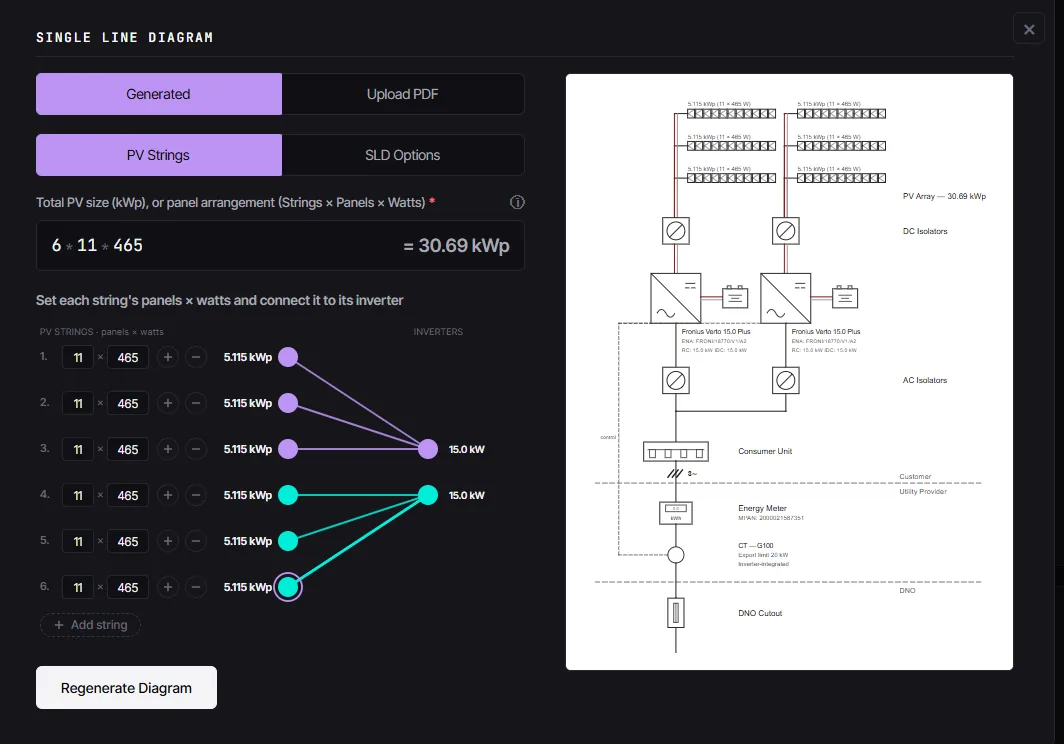
An SLD is a simplified wiring drawing. One line stands in for each electrical path, and standard symbols stand in for the kit: the incoming supply and meter, the consumer unit, the inverter, the isolators either side of it, the array, the battery if there is one, and the export limiter on a G100 job.
The DNO engineer isn't marking your draughtsmanship. They're checking, at a glance, that the system's connected safely and matches the form: where generation ties into the installation, that isolation sits in the right places, DC isolation on the array side, AC isolation between the inverter and the consumer unit, and that what's drawn is what's declared on the form.
Here's a real generated one, so you can see what good looks like:
 Enlarge
Reading it top to bottom: the PV strings feed the inverter, isolators sit on both the DC and AC sides, the AC side lands in the consumer unit, and the supply runs through the meter to the DNO's cutout. A battery comes off as its own branch with its own protection. On a G100 job the export limiter and the CT position show too, because the engineer wants to see where the system's being measured and held. Every pack needs a drawing that tells this story for the actual system going in, not a generic one lifted off the last job.
How CLRD handles this
Type test references and the ENA register
Every mainstream inverter sold in the UK has been type tested against the ENA's connection requirements, and each tested model carries a reference in the ENA register. Quoting that reference on the form is how you prove the kit behaves properly on the network during a fault, that's what spares a small job from a full engineering study.
To find one by hand you search the ENA register by manufacturer and model and copy the reference exactly. The classic mistakes: quoting the reference for a different model variant, or using a superseded entry for kit that's been re registered. Either one gets the pack queried, and the frustrating part is the inverter's usually fine, it's the reference that's wrong.
This is also where export limitation ties back in. If the job's export limited inverter integrated, the inverter doing the limiting has to be one that's type tested to hold that setting, and the declared limit has to match what's set at install and what's drawn on the SLD.
How CLRD handles this
Part 05
Doing it, start to finish
The walkthrough. Follow this in order and you'll have done it properly, whether it's your first application or your five hundredth.
Before you start: gather these
Ten minutes of gathering saves the resubmission later. You need:
- The MPAN, from the electricity bill.
- The full site address, exactly as the supply is registered.
- The inverter make and model, and its type test reference from the ENA register.
- The panel layout and rating: how many panels, their kWp, string arrangement.
- Battery details if fitted: make, model, inverter rating, its own type test reference.
- The supply details: single or three phase, main fuse rating if known.
- A signed letter of authority if applying for someone else.
First job?
Filling in the G98 and G99 application forms
Every field on these forms is learnable, and most are the details you just gathered. But this is exactly where the industry loses its evenings: one wrong entry and the whole pack comes back weeks later. The parts that catch people out:
Capacity figures. The DNO cares about the inverter's rated AC output, not the panel kWp. A 5kWp array on a 3.68kW inverter is a G98 job. Quote the inverter rating in the capacity field, and be consistent everywhere it appears.
Per phase, not total. On three phase supplies, limits and declarations are per phase. Split the figures correctly, and say which phase a single phase inverter lands on.
Equipment references. Copy the type test reference character for character. The engineer will look it up, and a mismatch triggers a query even when the kit is fine.
The diagram agrees with the form. Same inverter, same battery, same limiter, same everything. Most rejections are disagreement between documents, not wrong engineering.
First job?
Where and how to send it
Applications reach the DNO through their online channels: the ENA's shared submission portal, which carries your G98 or G99 application form to the network, individual DNO portals, and in some regions still by email to the connections team. The route matters less than people think, because the channel is just transport.
Here is the part that matters: none of those channels check your engineering. The portal is free and the form is free, but being right first time is not. A submission channel will happily accept the wrong form with mismatched references and pass it to a DNO engineer, who bounces it weeks later. Where the time and money go is never the submitting, it's the correcting. Whatever channel you use, the quality of the pack is decided before you press send.
How CLRD handles this
What happens after you submit
For a G98 notification, nothing needs to come back. The DNO records it, and may acknowledge it. Keep the submission confirmation with the job file and you're done.
For a G99 application, the DNO first acknowledges receipt, then assesses. Smaller type tested jobs usually come back in around two weeks, with larger ones needing a design study taking up to around ten. Fast Track eligible jobs are sooner still. The answer is one of three things: an approval, often called a connection offer, a request for more information, or a refusal with reasons, which at domestic scale is rare and usually really means "not without export limitation or reinforcement".
If the stated window passes with silence, chase with your application reference. Politely and in writing, so the trail exists.
First job?
If it comes back: fixing and resubmitting
A query or rejection isn't a disaster, it's a list of what to fix. Read exactly what the engineer flagged, fix precisely that, and resubmit quoting the original reference so it stays with the same case rather than joining the back of the queue as a new one.
The industry's most common bounce reasons, in rough order: a type test reference that doesn't match the declared inverter, an SLD that disagrees with the form, a missing or unsigned letter of authority, a wrong MPAN, capacity declared as panel kWp instead of inverter output, and jobs submitted on G98 that should have been G99 because of what was already on site.
Every one of those is avoidable at desk stage, which is why the checklist at the start of this part earns its keep.
After approval: commissioning and closing the loop
A G99 approval isn't the end. Install the system, commission it, and send the DNO the commissioning confirmation the offer asks for, that's what moves the connection from "approved" to "connected" in their records. Some DNOs include witness testing on larger jobs.
Then keep everything: the application, the approval, the commissioning evidence, the final SLD. The next section explains why that folder matters years after everyone's forgotten the install.
Part 06
Special situations
Three cases where the standard logic bends a little.
Batteries and storage
A battery is generation as far as the network's concerned. Its inverter can export just like solar can, so adding one is never paperwork free. On a new combined install, the battery's inverter counts toward the total that decides G98 or G99. Retrofit one to existing solar and it's a fresh notification or application, and because the property's total usually crosses the 16A line at that point, it's very often the moment a household meets G99 for the first time.
The saving grace: a retrofit battery on type tested kit is exactly the profile Fast Track exists for, so it's usually days rather than the full window.
Three phase properties
Three phase changes the arithmetic, not the principle. The 16A limit applies per phase, so a three phase property can host roughly 11kW of evenly spread generation and still sit inside G98. The catch is "evenly spread": a single phase inverter dumping 8kW onto one phase of a three phase supply is over the limit on that phase, and that's a G99 job even though the total looks modest.
Declare which phase each inverter sits on, and where possible balance across all three. The imbalance is what network engineers actually worry about.
New builds and multiple properties
New build developments add two wrinkles. First, the network is often owned by an IDNO rather than the regional DNO, so the paperwork goes to a different desk, same standards, different letterhead. Second, solar across a whole development is assessed as a cluster: fifty houses each under the G98 limit still add up to serious export on one bit of network, so developers and housing programmes deal with the operator at scheme level rather than plot by plot.
And this is about to be a much bigger part of the industry's workload. Under the Future Homes Standard, published as the Part L 2026 update, every new home in England built to the new regs needs solar PV equivalent to 40% of the dwelling's ground floor area, or a reasonable amount where that's not achievable. It comes into force on 24 March 2027, with a transition window running to 24 March 2028 for plots already under way. Batteries weren't mandated in the end, but solar effectively was. More on that in the changes section below.
Part 07
Staying right
The habits that keep a job defensible long after it's finished, and where the rules go next.
Audits and record keeping
Solar work gets audited from more directions than most trades: MCS audits installers, DNOs audit connections, insurers and buyers audit properties. Years after an install, someone may ask for the original application, the approval, the as built SLD and proof of submission.
The industry's default filing system is a mix of inboxes, shared drives and a folder in the van, and that's exactly where audits go wrong. Whatever your system, make it one place per job, kept for the long term: application, correspondence, approval, commissioning evidence, final diagram.
How CLRD handles this
The mistakes that cause the misery
If this guide compresses to one list, it's this one. The mistakes behind most delayed connections:
- Treating the battery as an afterthought and blowing through the G98 limit.
- Quoting panel kWp where the form wants inverter output.
- Copying a type test reference for the wrong model variant.
- An SLD that doesn't match the form, usually after a late kit substitution.
- Forgetting what's already installed at the property counts toward the threshold.
- No letter of authority when applying on the owner's behalf.
- Energising a G99 job before the approval arrives.
- Not closing the loop with commissioning confirmation after approval.
What's changing: the rules on the horizon
This corner of the industry doesn't stand still, and a guide that pretends the rules are finished would age badly. The changes worth watching as of 6 July 2026:
Solar as standard on new homes. The Future Homes Standard makes solar effectively standard on new homes in England, in force from 24 March 2027 with a transition window to 24 March 2028. That turns DNO applications from a retrofit trade into part of volume housebuilding, with scheme level network conversations and IDNO involvement becoming the norm rather than the exception.
Two way EV charging. Vehicle to grid technology puts car batteries on the network as exporters, and the connection paperwork for it is being formalised. A new application form for two way EV equipment is expected, and once it lands the routing logic in this guide gains a branch.
A more flexible network. The wider direction of travel is toward flexible connections: arrangements where the network manages exports dynamically instead of sizing everything for the worst case. Export limitation under G100 was the first mainstream taste of this, expect more of the same thinking at domestic scale.
We update this page when the standards move, the date at the top is the promise. If something here has been overtaken by events, tell us and we'll fix it.
Part 08
Reference
The quick answers and the jargon, for when you just need the one thing.
The industry FAQ
Straight answers to the questions people actually ask. For questions about CLRD itself, the CLRD FAQ is the place.
What is a DNO application?
It's how you tell the Distribution Network Operator that generation, usually solar or a battery, is being connected to their network at a property. Small systems get notified after the install under G98. Larger systems need approval before the install under G99.
What is included in a DNO application pack?
The completed G98, G99 or G100 form, a single line diagram, the inverter's ENA type test reference, the property's MPAN, a letter of authority if you're applying on the owner's behalf, and any supporting documents the DNO asks for, like export limitation evidence on G100 jobs or a photo of the cut out.
How do I submit a DNO application online in the UK?
Through the DNO's online channels, the industry's shared portal or the DNO's own, with some regions still taking email. Submitting is the easy part, the channels are free. What they don't do is check the pack is right, so an incorrect one comes back weeks later. The full walkthrough is in the submission section of this guide.
What documents does the DNO need for solar panels?
For a typical domestic install: the form for your route, a single line diagram, the inverter make, model and type test reference, and the MPAN. Commercial and export limited jobs usually add site plans and G100 evidence.
Do I need DNO approval to install solar panels?
Depends on size. At or under 16A per phase, roughly 3.68kW, you connect first and notify within 28 days under G98. Above that you apply under G99 and wait for approval before you energise.
What does a DNO application cost?
For typical domestic and small commercial, usually no fee for the application itself. The real cost is time, gathering the references, drawing the SLD, filling the form. Larger G99 connections that need network studies can carry DNO assessment charges, which the DNO quotes before work starts.
How long does a DNO application take?
G98 is a notification, so no waiting to connect, and so is G99 SGI-1, which you install then notify. Where an application is needed, smaller type tested systems are usually answered in around two weeks, stretching to around ten where a full design study is required. It varies by DNO and how busy the local team is. Fast Track jobs come back much sooner.
Can I submit a DNO application myself, without an installer?
Legally yes, the owner can apply, or anyone acting for them with a signed LOA. But the paperwork standard is identical whoever submits it, the engineering requirements still apply in full, and without MCS certification most export tariffs are closed to you. That's why in almost every case the installer runs it.
Can I track a DNO application after I send it?
If you applied through a portal you can log in and check the status. If you applied by email you're relying on the DNO to reply, so keep the acknowledgment and chase politely with the reference if the assessment window passes.
What is the difference between a DNO and my energy supplier?
Your supplier, Octopus, EDF, whoever, sells you electricity and sends the bill. The DNO owns and runs the wires, poles and substations that physically deliver it. You can switch supplier any time. You can't choose your DNO, it's fixed by where the property is.
Why was my DNO application rejected?
Usually something small and avoidable: a type test reference that doesn't match the inverter, an SLD that doesn't match the form, a missing LOA, a wrong or mistyped MPAN, or the wrong route entirely. The rejections section of this guide lists the common ones and how to dodge each.
Does a battery need a DNO application too?
Yes. A battery is generation as far as the network is concerned, because it can export. Adding one to existing solar usually means a fresh notification or application, and it can change which route the job takes.
What is a G98 form?
The G98 form is the notification you submit for a smaller system, at or under 16A per phase, roughly 3.68kW. You connect the system first, then send the completed G98 form to the DNO within 28 days of commissioning. It records what was installed, it is not an approval you wait for.
How do I fill in a G99 application form?
Quote the inverter's rated AC output, not the panel kWp, and keep that figure consistent across the whole form. On three phase supplies give the figures per phase, and say which phase a single phase inverter lands on. Copy the ENA type test reference exactly, and make sure the single line diagram matches the form on every detail. Most rejections are documents disagreeing with each other, not wrong engineering.
Glossary
DNO
Distribution Network Operator. The company that owns and operates the local electricity network in your region. There are six covering Great Britain.
IDNO
Independent Distribution Network Operator. A company that owns smaller local networks, often on new housing developments, connected into a DNO's wider network.
ENA
Energy Networks Association. The industry body that writes the engineering recommendations the DNOs work to, including G98, G99 and G100.
G98
The route for small generation, at or under 16A per phase. Connect first, notify the DNO within 28 days of commissioning.
G99
The route for everything above the G98 limit. Requires DNO approval before the system is energised.
G100
The standard for export limitation. Used alongside G99 when a system limits how much it exports to the grid.
Fast Track
A streamlined G99 assessment for smaller, fully type tested systems that meet set criteria. Decisions in days rather than the full assessment window.
MPAN
Meter Point Administration Number. The 13 digit number on the bottom line of the supply number block that identifies a property's electricity supply point. It is on the electricity bill. The full block is 21 digits, but forms ask for the 13 digit MPAN.
SLD
Single line diagram. A simplified electrical drawing showing how the generation connects to the property's existing installation.
LOA
Letter of authority. A short signed document allowing an installer or agent to deal with the DNO on the property owner's behalf.
Type test (FTT)
Fully type tested. Proof that an inverter has been tested against ENA requirements. Each approved model has a reference in the ENA register.
Export limitation
Configuring a system so it cannot export more than an agreed amount to the grid, which can make a connection acceptable on a constrained network.
Connect Direct
The ENA's shared online portal for transmitting G98 and G99 applications to the DNOs. It moves the application, it does not check it.
MCS
Microgeneration Certification Scheme. Certification for installers and products. Not a DNO requirement, but usually needed for export payment schemes.
SEG
Smart Export Guarantee. The scheme under which suppliers pay for electricity you export. Most SEG tariffs ask for MCS certification.
kW and kWp
Kilowatts. kW is power at a moment in time, kWp is the rated peak output of the panels. The DNO cares most about the inverter's output rating.
About this guide
This guide is maintained by the team at CLRD and reviewed against the current ENA standards. It's written to be useful whether or not you ever use our software, share it, link to it, send sections to whoever needs them. It is general guidance, not engineering or legal advice for a specific installation, when in doubt, talk to your DNO.

Reviewed by Andy Goode
Founder of CLRD and MCS certified installer. Years on the tools submitting these packs before building the platform; he checks this guide against the current ENA standards.
Connect with Andy on LinkedIn → Enlarge
Rather not do any of this by hand?
CLRD builds the whole pack from one set of install details and routes it to the right DNO automatically.