Feature · Fast Track applications
DNO Fast Track, get connected sooner.
Where Fast Track applies, CLRD routes you straight to it, automatically. Less back and forth with the DNO. Quicker decisions. Faster jobs through.
What it is
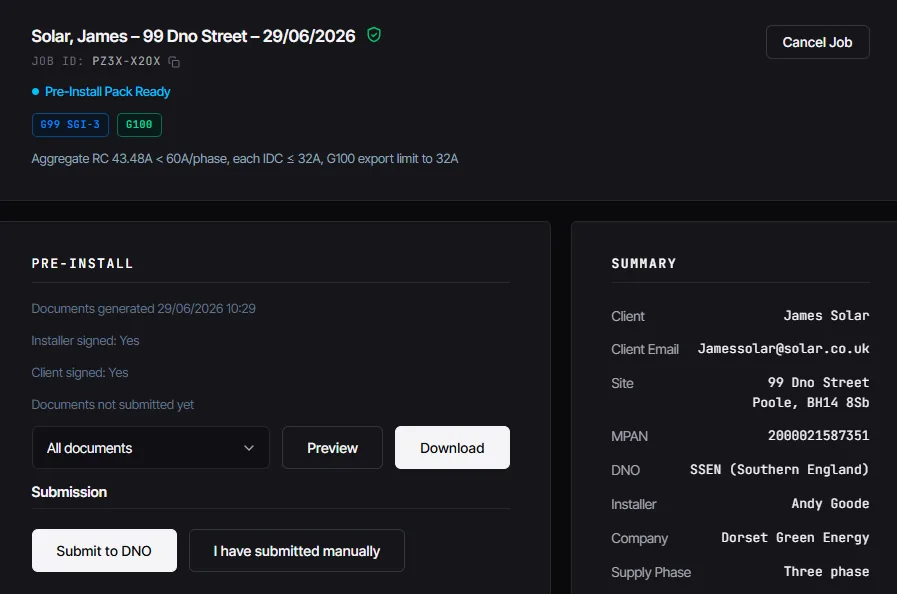
Where the install qualifies for Fast Track, CLRD routes the DNO application straight to it and assembles the right pack. It also captures the electrical measurements and photographs some DNOs ask for before they will approve, and sanity checks them before you submit.
Why it matters
Different DNOs have different practices, and what unlocks a faster decision varies between them. Getting it right can be the difference between an application that goes straight through and one that escalates to a DNO engineer. Years of experience of what each one actually asks for is built into CLRD, so the right measurements and photographs are captured and checked before you submit.
Especially powerful for battery retrofits and export limited installs.
- Auto detected from site details. No checklists to memorise.
- Right pack, right route, every time.
- Captures the cut-out photograph now required nationally for connect and notify, and the loop impedance readings SSEN ask for on an SGI-3.
- Photograph the cut-out at survey on every job, so the pack is never waiting on a second visit.
- Falls back to standard G99 cleanly if Fast Track doesn't apply.
 Enlarge
In practice
What changes on the next job.
Route resolved first
The submission route is worked out from the job data, so Fast Track is spotted rather than remembered.
Loop impedance captured
Phase to neutral and phase to earth readings recorded against the job, with the voltage as the tester displayed it.
Photographs attached
The supply termination and the meter mid measurement, held with the job rather than lost in a phone gallery.
Each DNO's own requirements
What one DNO asks for is not what the next one asks for. CLRD knows the difference and asks for the right things.
Qualification checked as you go
Readings are checked against the qualifying conditions while you enter them, not after the DNO reads them.
Clean fallback
If the job doesn't qualify it routes to the standard application, with nothing to redo.
Before & after
With CLRD vs. without.
See fast track applications on your own jobs.
A 30-minute demo with a real install, yours or ours.