Feature · Intrinsic Design Capacity
IDC, filled in from over 4,000 inverter datasheets.
The ENA register doesn't publish IDC, yet it decides G98 or G99. We read over 4,000 inverter datasheets, checked each figure by hand, and CLRD fills it in.
What it is
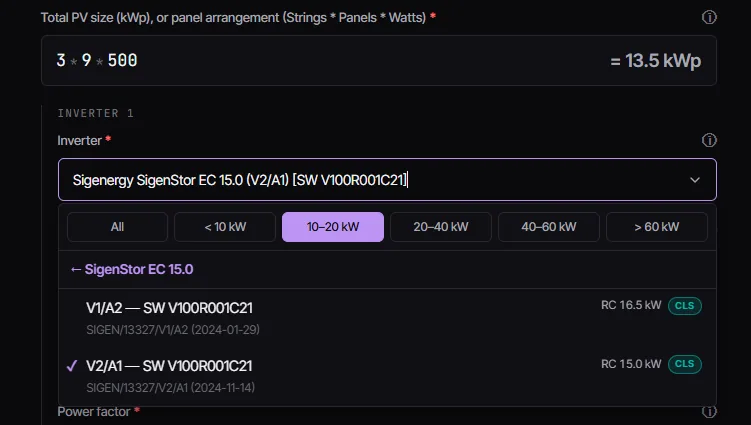
Intrinsic Design Capacity is the most an inverter was designed to put out. Usually it matches the Registered Capacity on the ENA register. But some inverters are software limited at the factory to a lower Registered Capacity than the hardware can deliver, and for those the IDC is higher. The register doesn't say which. CLRD does: pick one of those inverters and its IDC fills itself in.
Why it matters
IDC is one of the G98 tests. An inverter with a Registered Capacity of 16 A or under, but designed for more, is not G98: it goes as a G99 SGI-1 notification, on a different form. Above 32 A it rules out the SGI procedures altogether. Get the IDC wrong and the job is filed under the wrong procedure, on a form you signed.
The figure most installers never know to look for, found for you.
- Over 4,000 inverter datasheets read, every figure checked by hand.
- Pick the inverter and its IDC fills itself in.
- Still yours to change if the unit on the wall differs. Leave it blank on any other inverter and IDC equals the Registered Capacity.
- Routing reads it straight away: an inverter designed above 16 A goes G99 SGI-1, not G98.
 Enlarge
In practice
What changes on the next job.
No datasheet hunt
The figure the ENA register leaves out, already found.
The right form
The gate between G98 and SGI-1 is applied on the real figure.
Checked by hand
Every figure verified by a person, not scraped and hoped for.
Before & after
With CLRD vs. without.
See it fill in the IDC on your own jobs.
A 20-minute demo with a real install, yours or ours.